
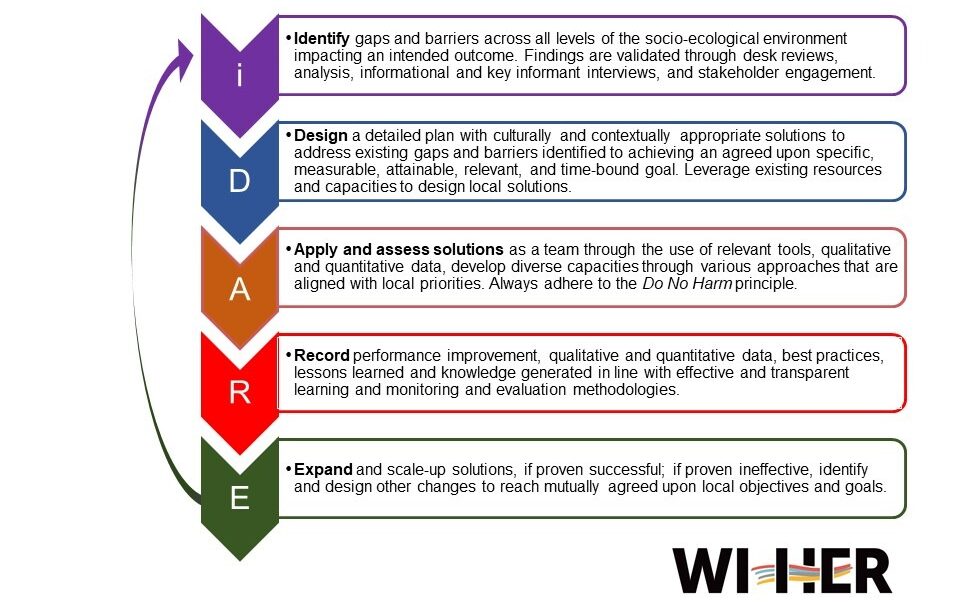
At WI-HER, we believe in supporting individuals to be at the heart and in the driver’s seat of designing and delivering human-centered solutions, which do no harm. WI-HER Founder and President Dr. Taroub Harb Faramand developed an innovative and results-based methodology called iDARE (Identify, Design, Apply/Assess, Record, Expand) to put this principle into practice.
As a simple but science-based methodology, iDARE enables stakeholders — whether governments, service providers, civil society organizations, or community members — to assess their existing local system, identify gaps and barriers, and then design, test, and scale effective solutions. As a key step in iDARE, individuals record performance improvement, qualitative and quantitative data, best practices, lessons learned and knowledge generated in line with accountability, effective, and transparent learning and monitoring and evaluation methodologies.
The results of iDARE are clear: effective program design, implementation, monitoring, evaluation, and learning that truly enables those with whom we work to achieve improved outcomes while being mindful of unintended negative consequences (Do No Harm principle).
Our approach
iDARE takes quality improvement to the next level by incorporating behavior change theory and human-centered design into improvement science. iDARE allows the identification and leveraging of the strengths of team members to operate quickly, nimbly, and through a collaborative and continuous learning, adaptation, and improvement approach.
WI-HER’s team also applies the methodology in leadership training, where participants rapidly identify and analyze a problem they want to work on, whether related to their performance, program management or implementation, and to design solutions for testing while being coached throughout the process. We observed rapid and effective change among participants and a feeling of ownership and trust. Through the use of iDARE, our team, stakeholders, and clients go beyond quality improvement to gain a deeper understanding of the factors that perpetuate gaps and barriers, enabling them to design contextually appropriate solutions that contribute to desired outcomes.
iDARE can be applied to any sector — health, education, energy, environmental conservation, and economic growth, to name a few — and to any technical area, including systems improvement, policy reform, and social and behavior change. It has been used domestically and globally with tremendous results and has been adopted and independently applied by local stakeholders.
For more information on iDARE, including resources, contact us at info@wi-her.org